

One daily review
Spaced repetition brings back vocabulary, grammar, and kanji right before you’d forget them, all in one queue.
Language through stories
The rigor of a textbook, but way more fun.
Launching with Japanese, with more languages to come.
How it works
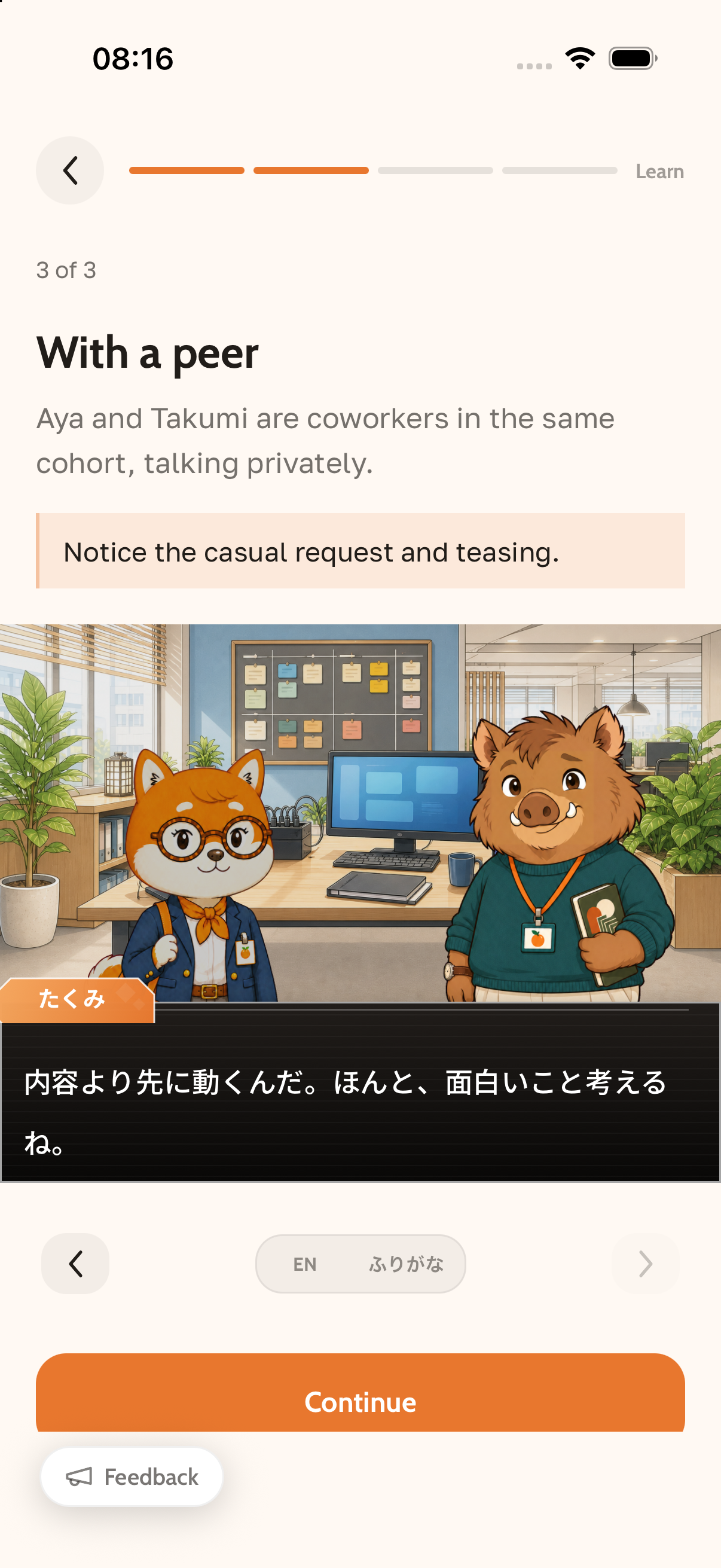
Lessons play out like a video game, with a cast of characters you come to know and love.
The research basis: People understand and remember stories better than plain explanations, so every lesson is set in a scene. (Mar et al., 2021)
Inside one lesson
Real content from the 〜ばいい grammar lesson, so you can see what it’s like to learn with Clementine.
The cast uses the pattern in conversation.

お父さん、町内会の掃除は初めてなんだけど、何をすればいい?
Dad, this is my first neighborhood cleanup. What should I do?

公園の奥に受付があるから、そこで集合場所を確認すればいいよ。
There is a reception desk at the back of the park, so you just need to confirm the meeting place there.
Hover or tap a word for its meaning.
Match each stem to its ending.
Drag an ending to a stem, or tap the two pieces in either order.
Write your own sentence.
Aya forgot her umbrella and needs to get to the station. Tell her to buy one at the convenience store.
疲れているなら、早く寝ればいいよ。
If you’re tired, just go to bed early.
In the app, AI reads anything you write and explains what works and what a native speaker would say.
The research basis: Seeing an example of grammar being used correctly before learning the pattern makes it easier to learn, and producing the pattern yourself helps you remember it better than just reading it. (Schwartz & Bransford, 1998; Bertsch et al., 2007)
Ways to practice
Real recordings from the app. Press play to watch a text conversation, a work email, an article with questions, and kanji writing.
Chat with a character in Japanese. They reply to what you actually wrote, and you get a note on each message.
Read a work email, write a reply in Japanese, and get feedback on tone and content.
Read short articles at your level and answer questions that check you understood. Review them later with furigana, English, and notes.
Meet each character in a real word, learn where it comes from, then trace it stroke by stroke.
The research basis: Practicing through real tasks, like answering a text or an email, builds usable language, and feedback on your own writing improves accuracy. (Bryfonski & McKay, 2019; Kang & Han, 2015)
Meet the cast
The same characters come back lesson after lesson, so you hear how Japanese changes based on whether you’re speaking to your boss, your best friend, or a family member.

Frontend engineer at an IT startup. Capable, warm, and often a little late.

Aya’s best friend, a freelance illustrator who always tells her the truth.


Guest relations manager at a Tokyo boutique hotel. Friends with Aya since high school.

Aya’s junior at work. Eager, very talkative, and a little worried about everything.

Aya’s boss, head of product development. Cool under pressure.

Aya’s boyfriend, an architect. Steady, thoughtful, sometimes spacey.

Aya’s little brother. College freshman, baseball player, eager and bold.

Aya’s mom, a jazz piano teacher who occasionally performs. Sweet but strict.


Aya’s dad, who manages construction sites. Practical and direct.

Aya’s neighbor. A retired cosmetic chemist and neighborhood volunteer who loves to gossip.
What you get
Reading, listening, writing, and speaking in one structured path, where each lesson builds on the last.
Spaced repetition brings back vocabulary, grammar, and kanji right before you’d forget them, all in one queue.
Clementine’s content, reviews, and quizzes are designed to mirror the JLPT, so your daily lessons count as exam prep.

Go deeper into business, travel, internet slang, and more. In development, with more topics to come.
Role-play speaking and writing with the cast and get immediate feedback on what worked and what a native speaker would say instead.
The research basis: Recalling something from memory, spaced out over days, keeps it far longer than rereading it. That’s why review comes back on a schedule. (Roediger & Karpicke, 2006; Cepeda et al., 2006)
Made on both sides of the Pacific
We co-founded Orca, a crypto exchange with over $63B in total volume, and now we’re building the language-learning app we always wanted. We split our time between Tokyo and New York.

BS and MS in computer science from Stanford. Designer/engineer at IDEO and Coursera before co-founding Orca and Clementine. Forbes 30 Under 30. LinkedIn

Software engineer at the Ethereum Foundation and MongoDB before co-founding Orca and Clementine. Spent childhood summers in Nagoya.
A few things to know
Japanese first. Clementine is built to teach other languages too, and we’ll announce each one as it’s ready.
Between 3 and 15 minutes, so you can fit one in almost anywhere.
All of Clementine’s reading, writing, speaking, and listening exercises feature real-life scenarios, like planning travel, making work presentations, and speaking to your family. We’ll never waste your time learning nonsensical phrases.
All four skills (reading, listening, writing, and speaking) plus vocabulary, grammar, and kanji. You’ll write and say your own Japanese in situations like a work meeting or a text to a friend, and get feedback on each answer.
Yes. Courses are organized by JLPT level, and they also teach the speaking and writing the exam doesn’t test. We’re working toward every level and will announce which ones are ready at launch.
Yes. Lessons are designed around what helps people remember and use a language: stories and scenes instead of lists, an example before each rule, producing your own Japanese with feedback, and spaced retrieval for review. See Mar et al., 2021; Schwartz & Bransford, 1998; Bertsch et al., 2007; Bryfonski & McKay, 2019; Kang & Han, 2015; Roediger & Karpicke, 2006; Cepeda et al., 2006.
Spaced repetition brings back vocabulary, grammar, and kanji when it’s time to review them. Everything goes into one daily queue, so there’s no juggling separate apps.
Yes, AI is used to provide feedback on learners’ writing and speaking exercises. It’s also used for development of the content and app, though all Japanese content is reviewed by native speakers. We believe that AI is of the most value when it is used to enhance humans’ intelligence, and that learning a language is a great example of that!
You can unlock all content in Clementine with a monthly or yearly subscription. There will be no free mode, but we will offer a trial so you can see if it’s right for you before committing.
Join the beta using our signup form. We’ll contact you if you’re selected.
Your next chapter starts here
Sign up to try Clementine and share your feedback.
Join the beta